When I was a pre-teen, there were two things I could count on finding in our family’s deep freezer in the garage: ice cream and dead birds.
We all liked ice cream.
We were used to the dead birds.
After dinner, as someone collected the ice cream scoop, bowls and spoons, the following exchange from garage to kitchen wasn’t uncommon:
FETCHER OF ICE CREAM: “Where’s the Peppermint Stick? I can only find Butter Pecan?”
MOM: “It’s in there. Look next to the Owl. Or it could be under the Woodpecker.”
My Dad loves nature, and he’s more than a hobbiest or casual observer. He wants others to love nature and the science behind it, too. He finds real joy tramping in the woods and meadows and along back roads, creeks or old railroad tracks observing his surroundings and whatever might happen to be around his path. He sleuths out clues in leaf shapes, flowers, berries, tracks, animal poo, jaw bones and disturbances to identify the indigenous flora and fauna. And he’s good at it.
He is also a (retired) teacher, which means he sometimes brought back things from this treks for his classroom. Things like abandoned hornets nests, antlers, skulls, leaves to press, rocks, fluffs of fur, and, eventually, dead birds. Which went into the freezer for preservation – but only if they were in really good shape.
Somewhere along the line, he got a license and into cahoots with a local taxidermist, who would thaw and bring the feathered specimens back to lifelike, so Dad could arrange for them to be displayed in glass at the elementary school where he worked or the town library.
My Dad loves nature, and he loved (still loves) teaching others about it.
Which explains the dead birds in the freezer. And why it came as no surprise when my sister Eunice and I realized we’d be enduring the 12-some-hour return trip from the Delmarva Peninsula to Goshen, Indiana, breathing Eau d’ Dead Horseshoe Crab* from our backseats in the family minivan.
I was 13 the summer we packed up and drove to Ocean City, Maryland, for the first non-camping vacation I can remember. (My parents had found an inexpensive and perfect little rental cottage where the proceeds benefitted a program to help runaway youth. They arranged this without the miracle of internet, by the way.)
We spent days on Rehoboth Beach sunning or dozing under an umbrella, where there was a cooler packed full of bologna-MiracleWhip-and-lettuce sandwiches, carrot sticks, canisters of Planter’s Cheez Balls and packages of Hydrox cream-sandwich cookies. It is a known fact that these things are most delicious eaten chilled from a cooler on the beach.
That’s where I learned to body-surf waves and what it’s like to slurp in a nose-full of the salty Atlantic, struggling exhausted from the ocean floor against the suck of the tide after being crushed by bad timing or foolishly turning my back to the waves. And it’s where I watched momentarily exposed periwinkles wiggle into the sand and small crabs scuttle toward the sea as the curtain of water on the shore pulled open and closed.
We strolled the weathered Ocean City Boardwalk and ate salt water taffy and licked ice cream cones and watched a man draw caricatures. We bought fresh produce from roadside stands. We put on our “good shorts” to eat a fancy meal in a restaurant, where my parents insisted everyone order crab of some kind—and where, when they learned that our waitress was also a teacher, making ends meet with a summer waitressing job, they tipped extra with money they probably didn’t have to spare themselves.
But as we hopscotched from Delaware to Maryland to Virginia and back, the ultimate destination (in my mind, anyway) was the Assateague Island National Seashore.
Like my classmates at Middlebury Elementary, I’d grown up reading the Marguerite Henry “Misty” series, set on Chincoteague Island, dreaming, as young girls did back then, about the wild ponies and perhaps taming and riding one bareback, galloping along the seashore as my long, blonde tresses flowed in the ocean wind.**
Assateague Island is north and across Chincoteague Bay. Assateague, too, has wild ponies. (“Chincoteague ponies” are actually Assateague Horses.) They are, I am happy to report, just as magnificent as advertised and imagined. And, according to signs posted in the area, they bite. Being a Rule Follower and Sign Obeyer, I didn’t test the warning. I didn’t even come close. No wild ponies were tamed or ridden, which I think was prohibited anyhow.
Like the beautiful horses, the Assateague Island National Seashore, too, is wild and magnificent. We went a few times, since (as my sister reminds me) the cottage rental provided a National Parks Pass.
And I’m pretty sure it was on Assateague Island that Dad found the horseshoe crab carcasses.
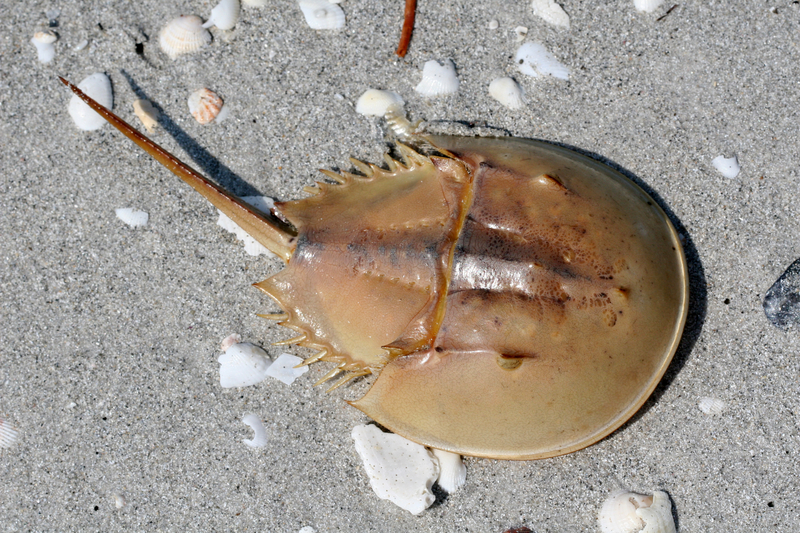
(Photo credit: 22183117 © Kevin Knuth – Dreamstime.com)
Now, if you’ve never seen a horseshoe crab, they are downright scary looking creatures. They’ve existed since before dinosaurs, and they look it. I read somewhere that they’re actually more closely related to ticks and spiders than they are kin to crabs; so there’s that creepy factor, too. But the truth is, they’re harmless to people (helpful, actually); and their “tail” spears—which make them look like the armored-car version of a sting or manta ray—are used mainly as an appendage to help them flip over.
Another fun fact: Horseshoe crab blood is a scientific marvel. It can be used to test whether a vaccine or drug in development is safe, or if it contains bacteria harmful to humans. (Read this for more about the amazing horseshoe crab.)
So, when my Dad found those dead crabs, we probably already knew they were going home with us. Because of nature and science and teaching. They travelled with us many miles, wrapped carefully in plastic bags and stinking up the backseat. I’m sure they took a turn in the freezer with the birds.
And they made it to Dad’s classroom where for years they were, I’d like to think, admired for their creepiness, incredible to believe, fascinating all who beheld them, giving cause to consider the broader world.
*To be clear, they were, as were all the specimens Dad collected, already dead when he found them.
**Yes. I am a brunette, and if you knew me at that age, you’ll know I was a brunette with very short hair. Thirteen-year-old-Chicoteague-pony-riding-Amy has long, blonde hair and can tame wild horses. That girl’s got game and amazing hair.

